German Cyber Security 2026: NIS2, the AI Act, and the Rise of the AI-Powered CISO
This is our fifth annual review of the German cyber security landscape.
If you’ve been following this series since 2021, you’ve watched the narrative shift from ransomware panic to supply chain anxiety to the geopolitical shock of the Ukraine war. Each year brought a new dominant theme. Each year, the BSI’s Lagebericht got a little grimmer.
2026 is different. Not because the threats have changed — ransomware is still the number one menace, and attackers are only getting smarter. It’s different because the regulators finally caught up.
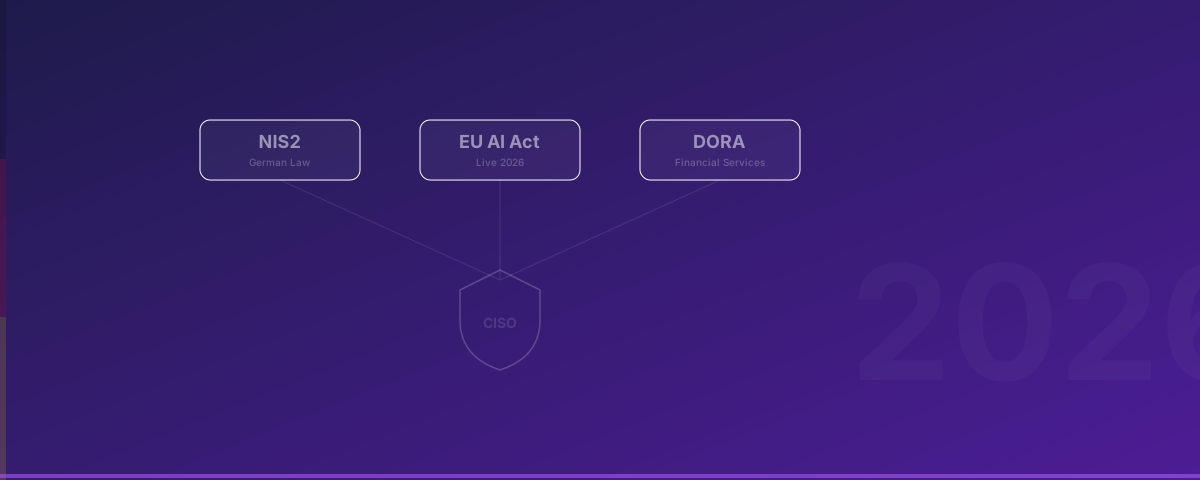
NIS2 is no longer a directive people argue about on LinkedIn. It’s German law. The EU AI Act isn’t a future concern — the first prohibitions are already enforceable. DORA is live for financial services. And somewhere in the middle of all this regulatory upheaval, a quiet revolution is happening: CISOs are discovering that the same AI technology creating new attack vectors can also handle 60–70% of their compliance workload.
Welcome to 2026. Let’s break it down.
Trend 1: NIS2 Enforcement Has Arrived
Let’s start with the elephant in the room. The NIS2-Umsetzungs- und Cybersicherheitsstärkungsgesetz (NIS2UmsuCG) — Germany’s transposition of the EU NIS2 Directive — is now law. After months of political delays, parliamentary debates, and industry lobbying, the legislation passed and enforcement has begun.
The impact is massive.
Who’s in Scope?
Approximately 3,500 German companies are newly in scope under NIS2, on top of the ~800 operators of critical infrastructure already regulated under the original IT-Sicherheitsgesetz 2.0. This expansion covers 18 sectors — from energy, transport, and healthcare (the usual suspects) to digital infrastructure, ICT service management, food production, waste management, and manufacturing.
Here’s what catches Mittelstand companies off guard: the thresholds are sector + size, not criticality. If you have 50+ employees or €10M+ turnover and operate in a covered sector, you’re likely in scope. No designation letter from the BSI required. You have to self-assess.
And that’s the first problem. Our conversations with German mid-market companies suggest that a significant portion of newly in-scope organisations still haven’t completed a formal NIS2 gap assessment. Many don’t even know they’re affected.
What Article 21 Actually Requires
NIS2’s Article 21 is the meat of the directive. It mandates “appropriate and proportionate technical, organisational and operational measures” across ten specific domains:
- Risk analysis and information system security policies
- Incident handling
- Business continuity and crisis management
- Supply chain security (more on this later)
- Security in network and information systems acquisition, development, and maintenance
- Policies and procedures to assess the effectiveness of cybersecurity risk-management measures
- Basic cyber hygiene practices and cybersecurity training
- Policies and procedures regarding the use of cryptography and encryption
- Human resources security, access control policies, and asset management
- Use of multi-factor authentication, secured communication systems, and secured emergency communication
If that list looks like ISO 27001 with extra steps, you’re not wrong. But NIS2 adds teeth that ISO certification alone never had.
The Incident Reporting Reality
The new reporting obligations are where theory meets painful practice:
- 24 hours: Early warning to the BSI after becoming aware of a significant incident
- 72 hours: Full incident notification with initial assessment, severity, and impact
- 1 month: Final report including root cause analysis, mitigation measures, and cross-border impact
For companies used to quietly handling breaches internally, this is a culture shock. The 24-hour early warning is particularly aggressive — it requires reporting before you fully understand what happened. Many incident response teams aren’t built for that cadence.
Penalties That Bite
NIS2 penalties for essential entities reach up to €10 million or 2% of global annual turnover, whichever is higher. Important entities face up to €7 million or 1.4% of turnover. And critically, the German transposition includes personal liability for management — Geschäftsführer and Vorstand members can be held individually responsible for cybersecurity failures.
This isn’t theoretical. The BSI has been staffing up its enforcement capabilities throughout 2025. The first audits and enforcement actions are expected in H1 2026.
Bottom line: If your NIS2 compliance programme isn’t well underway, you’re already late. If you haven’t started, you’re in trouble. We published a detailed NIS2 Readiness Guide — start there.
Trend 2: The EU AI Act Goes Live
While NIS2 dominated the cybersecurity headlines, the EU AI Act (Regulation 2024/1689) has been quietly reshaping the compliance landscape.
The Timeline That Matters
The AI Act entered into force in August 2024, with a staggered enforcement timeline:
- February 2025: Prohibitions on unacceptable-risk AI systems (social scoring, real-time biometric surveillance in public spaces with limited exceptions, manipulation techniques)
- August 2025: Obligations for general-purpose AI (GPAI) models, including transparency requirements
- August 2026: Full obligations for high-risk AI systems (Annex III categories)
We’re now past the first enforcement milestone. AI systems that perform social scoring, deploy subliminal manipulation techniques, or exploit vulnerabilities of specific groups are illegal in the EU. The real question for German companies: do you know if any of your AI tools cross these lines?
High-Risk AI: Closer Than You Think
The August 2026 deadline for high-risk AI systems is the one keeping compliance teams up at night. Annex III covers AI used in:
- Employment and worker management (CV screening, performance monitoring, task allocation)
- Access to essential services (credit scoring, insurance pricing)
- Law enforcement and border control
- Education and vocational training (automated grading, admissions)
- Critical infrastructure management
German companies using AI for HR processes — and by now, most large employers are — need to prepare for conformity assessments, risk management systems, data governance obligations, transparency requirements, and human oversight mechanisms.
ISO 42001: The New Standard
ISO/IEC 42001 (AI Management Systems) is rapidly becoming the governance framework of choice for AI Act compliance. We’re seeing adoption accelerate across German enterprises, often as a bolt-on to existing ISO 27001 implementations. The logic is sound: if you already have an ISMS, extending it to cover AI governance is a natural next step.
But certification alone won’t save you. The AI Act requires specific technical documentation, risk categorisation, and ongoing monitoring that goes beyond what ISO 42001 mandates out of the box.
Shadow AI: The Biggest Blind Spot
Here’s what worries me most. Every German enterprise I talk to has a Shadow AI problem. Employees are using ChatGPT, Claude, Gemini, Midjourney, and dozens of smaller tools — often with corporate data — without any governance framework, acceptable use policy, or even awareness from IT leadership.
Under the AI Act, deployers (not just providers) have obligations. If your employees are using AI tools to make decisions that affect people — hiring, credit, service access — your organisation may have compliance obligations it doesn’t even know about.
We wrote an entire piece on Shadow AI Governance because this problem is that urgent. If you haven’t read it, now is the time.
Trend 3: DORA Reshapes Financial Services
The Digital Operational Resilience Act (DORA, Regulation 2022/2554) has been effective since January 2025, and German financial services are feeling it.
What DORA Demands
DORA applies to banks, insurance companies, investment firms, payment institutions, and — critically — their ICT third-party service providers. For a financial centre like Frankfurt, this is seismic. The regulation requires:
- ICT risk management frameworks with documented policies, procedures, and governance structures
- ICT-related incident reporting to BaFin with strict timelines (not dissimilar to NIS2’s approach)
- Digital operational resilience testing, including threat-led penetration testing (TLPT) for significant institutions
- ICT third-party risk management, including a register of all third-party arrangements and concentration risk assessment
- Information sharing arrangements for cyber threat intelligence
The NIS2-DORA Overlap Problem
Here’s where it gets messy. Many financial institutions are in scope for both NIS2 and DORA. While DORA takes precedence as lex specialis for financial services cybersecurity, the overlap creates real compliance fatigue. Teams are juggling two sets of incident reporting requirements, two risk management frameworks, and two sets of auditors.
BaFin has been issuing guidance, but the practical reality is that compliance teams at German banks and insurers are stretched thin. The institutions that invested in unified compliance frameworks early are in far better shape than those trying to bolt DORA onto existing structures retroactively.
For ICT service providers to the financial sector, DORA introduces a new reality: the Critical Third-Party Provider (CTPP) designation, which brings direct regulatory oversight from the European Supervisory Authorities. If you’re a cloud provider, managed security service, or IT outsourcer serving German banks, your compliance obligations just expanded dramatically.
Trend 4: The AI-Powered CISO Emerges
Now for the trend I’m most excited about — and the one that will define the next five years of cybersecurity operations.
CISOs are discovering AI agents. Not the “AI-powered” marketing labels slapped on every SIEM and EDR product for the last three years. Actual autonomous agents that can perform meaningful GRC work.
The GRC Grunt Work Problem
Let’s be honest about what a CISO’s week actually looks like in 2026. It’s not threat hunting and strategic planning. It’s:
- Chasing evidence for audit controls
- Updating risk registers
- Reviewing vendor security questionnaires
- Writing policy documents that nobody reads
- Preparing board reports
- Managing compliance across multiple frameworks (ISO 27001, NIS2, AI Act, DORA, GDPR…)
This is grunt work. Important grunt work, but grunt work nonetheless. And it’s consuming 60–70% of security leadership’s time — time that should be spent on actual security strategy.
AI Agents Change the Equation
The new generation of AI agent platforms can handle a remarkable portion of this workload:
- Policy generation and maintenance: Draft policies aligned to specific frameworks, update them when regulations change, track version history
- Evidence collection: Automatically gather compliance evidence from cloud environments, ticketing systems, HR platforms, and infrastructure
- Vendor risk assessment: Process security questionnaires, analyse SOC 2 reports, flag gaps against your requirements
- Incident reporting: Draft NIS2-compliant incident reports from SIEM data within the 24-hour window
- Board reporting: Generate executive summaries from operational data, translated into business language
This isn’t science fiction. These capabilities exist today. The question is whether your security team is using them.
Conversational Compliance
The shift I find most interesting is from dashboard-based GRC to conversational compliance. Instead of logging into a platform, navigating to a dashboard, and interpreting charts, CISOs are asking AI agents questions in natural language:
“What’s our current NIS2 compliance status across all ten Article 21 domains?”
“Which vendors haven’t completed their annual security review?”
“Draft the 72-hour incident notification for the phishing incident we detected yesterday.”
This is a fundamentally different interaction model. It’s faster, more intuitive, and — critically — it makes compliance accessible to people who aren’t GRC specialists.
The Widening Gap
Here’s the uncomfortable truth: the gap between AI-augmented security teams and traditional ones is widening fast. Teams using AI agents are processing vendor assessments in hours instead of weeks. They’re generating audit evidence automatically instead of scrambling before certification audits. They’re producing board reports in minutes instead of days.
Teams that aren’t adopting these tools are falling behind — not gradually, but exponentially. In a regulatory environment that now includes NIS2, the AI Act, DORA, and GDPR simultaneously, the compliance workload has simply exceeded what human teams can handle manually.
If you’re curious about what an AI-powered compliance platform looks like in practice, we’ve been building exactly this.
Trend 5: Supply Chain AI Risk — The New Shadow IT
NIS2 Article 21(2)(d) explicitly requires organisations to address supply chain security, including “the security-related aspects concerning the relationships between each entity and its direct suppliers or service providers.”
In 2026, this has taken on an entirely new dimension: your vendors are deploying AI, and most of them aren’t telling you about it.
The Invisible AI Layer
Consider a typical German Mittelstand company’s vendor ecosystem:
- Your HR platform has added AI-powered candidate screening
- Your cloud provider is using AI for capacity planning and anomaly detection
- Your managed security provider has deployed AI agents for alert triage
- Your CRM vendor has embedded generative AI for email drafting and customer interaction summaries
- Your legal tech provider is using AI for contract analysis
Each of these AI deployments introduces new risks: data processing changes, model bias, hallucination risk, and potential AI Act obligations that cascade to you as the deployer. And most vendor contracts signed before 2024 don’t address any of this.
Third-Party AI Risk Assessment
The smart CISOs are already adding AI-specific questions to their vendor risk assessments:
- Does your product use AI or machine learning? If yes, for what functions?
- What data is processed by AI models? Is customer data used for training?
- Where are AI models hosted? Are they using third-party AI APIs (OpenAI, Anthropic, Google)?
- What AI governance framework do you follow? ISO 42001? NIST AI RMF?
- How do you monitor for AI-specific risks (bias, hallucination, drift)?
- Have you conducted an AI Act risk classification for your AI features?
If your vendor can’t answer these questions clearly, that’s a red flag. Under NIS2’s supply chain requirements, their AI risk is your AI risk.
The New Shadow IT
Five years ago, the big supply chain risk was Shadow IT — employees signing up for SaaS tools without IT’s knowledge. In 2026, the equivalent is Shadow AI in the supply chain: vendors deploying AI capabilities without adequate disclosure, governance, or contractual coverage.
This is the risk that most German companies are underestimating. It’s not the AI you’re deploying internally that will catch you out — it’s the AI your vendors are deploying on your behalf, with your data, without your explicit consent or oversight.
The Numbers: German Cyber Security in 2026
Let’s ground this analysis in data. Here’s where the German cyber security landscape stands:
The story these numbers tell is clear: regulatory ambition is outpacing organisational readiness. Germany has some of the most comprehensive cybersecurity regulation in Europe, but the implementation gap is real and growing.
The BSI’s 2025 Lagebericht zur IT-Sicherheit described the threat landscape as “more dynamic and complex than ever,” with particular concern about the convergence of state-sponsored actors, organised cybercrime, and AI-enhanced attack capabilities. The 2026 edition, expected later this year, is unlikely to paint a rosier picture.
One bright spot: organisations that have adopted AI-powered security tools are seeing measurably better outcomes. Mean detection times are dropping, incident response is faster, and compliance workloads are becoming manageable even as the regulatory burden increases.
What German CISOs Should Focus On in 2026
If I had to distil all of this into a priority list — and after five years of writing these reviews, I know that’s what you’re here for — here’s what German CISOs should focus on right now:
1. NIS2 Compliance — You’re Already Late
If you’re in scope and haven’t completed a gap assessment, stop reading this article and start one today. The enforcement clock is ticking. Key actions:
- Complete a formal NIS2 gap assessment against all ten Article 21 domains
- Establish the 24h/72h/1mo incident reporting capability (test it with a tabletop exercise)
- Brief your Geschäftsführung on personal liability implications
- Document your supply chain security measures (you’ll need them)
Our NIS2 Readiness Guide walks through each step in detail.
2. AI Governance Framework — Discovery First
You can’t govern what you can’t see. Start with Shadow AI discovery: find out what AI tools your employees are actually using. Then build:
- An AI acceptable use policy
- An AI risk classification aligned to the EU AI Act’s risk categories
- A process for evaluating and approving new AI tools
- Training for employees on responsible AI use
Read our guide on Shadow AI Governance for the practical playbook.
3. ISO 42001 Alongside ISO 27001
If you’re already ISO 27001 certified — and most German enterprises in the security space are — ISO 42001 is the natural extension. The frameworks complement each other, and dual certification positions you well for both AI Act compliance and customer trust.
Start the scoping exercise now. Certification bodies are seeing growing demand, and audit slots for H2 2026 are filling up.
4. Supply Chain AI Risk Assessment
Update your vendor risk assessment process to include AI-specific questions. Review existing contracts for AI disclosure clauses. For critical vendors, request:
- AI usage transparency reports
- AI governance documentation
- Data processing details for AI features
- AI Act risk classification for their products
This isn’t optional under NIS2. Article 21(2)(d) makes supply chain security a mandatory domain, and in 2026, supply chain security without AI risk assessment is incomplete.
5. Deploy AI Agents for Your Own Security Team
This is the “eat your own dog food” recommendation. If AI is transforming the threat landscape and the regulatory landscape simultaneously, the only sustainable response is to use AI to manage both.
The compliance workload of NIS2 + AI Act + DORA + GDPR is simply not manageable with manual processes and spreadsheet-based GRC. AI agents can automate evidence collection, policy maintenance, vendor assessment, incident reporting, and board communication — freeing your human team to focus on actual security strategy.
The teams that adopt AI-augmented GRC in 2026 will have a structural advantage over those that don’t. It’s that straightforward.
Looking Ahead
Five years of writing these reviews has taught me one thing: the German cyber security landscape only ever gets more complex. But 2026 feels like an inflection point.
For the first time, we have a regulatory framework that matches the scale of the threat. NIS2 brings real accountability. The AI Act addresses a technology that’s genuinely transformative. DORA closes the financial services gap. Combined, these regulations create the most comprehensive cybersecurity governance framework in the world.
The challenge now is execution. Regulation without implementation is just paper. And right now, too many German organisations — especially in the Mittelstand — are still in the “awareness” phase when they should be in the “implementation” phase.
The organisations that will thrive in this new environment are the ones that treat compliance not as a checkbox exercise, but as an operational capability. And increasingly, that means leveraging AI to manage the very regulations that govern AI.
It’s poetic, in a cybersecurity sort of way.
Need help navigating NIS2 compliance and AI governance simultaneously? That’s exactly where we sit — at the intersection of regulatory compliance and AI-powered security operations. Book a free assessment and let’s figure out where you stand.
This is the fifth edition of our annual German Cyber Security Review. Previous editions covered the ransomware epidemic (2021), supply chain attacks and Log4j (2022), the Ukraine war’s impact on European security (2023), and the regulatory preparation year (2024). Follow us for the 2027 edition.
Need help with this?
We help enterprise security teams implement what you just read — from strategy through AI-powered automation. First strategy session is free.